Showing posts with label Hunza. Show all posts

Thursday, July 9, 2009

Hunza Glacial Milk

Many people jump to the conclusion that the water diverted from glacial runoff was the source of special healing and life extending properties. The gardens were watered with mineral rich glacier water carried by an aqueduct system for a distance of 50 miles (80 m) from the Ultar Glacier on the 25,550 foot (7789 m) high Mount Rakaposhi.

Mount Rakaposhi elevation 7789 m. or 25,556 feet. The wooden aqueduct trough was hung from the sheer cliffs by steel nails hammered into the rock walls. Rocks beneath the glacier were ground into a fine powder or silt by the pressure and weight to give the water a slight milky color, thus it was described as "Glacial Milk."

There are those who claim the Hunza water is rich in cesium and potassium thereby making it rich with caustically (alkaline) active metals that prevent and cure cancer. Some modern doctors are giving cesium therapy treatments to cure cancer, but cesium does not cure cancer.

The glacier water used to flood the garden plots did provide many minerals or trace metals. The minerals were in the ground rock and not in the colloidal form as many claim. The following link gives a chemical composition of the glacial milk of Hunza. It may or may not be correct. Most of the other information on the following link is false.

Wednesday, July 8, 2009

The Original Hunza People


The story of Hunza is thought to have begun with Alexander III or Alexander the Great (July 356 BC to June 10, 323 BC), son of King Philip of Macedon (Ancient Macedonia west of Greece). Alexander was a brilliant warrior, more capable than his father. After his father's murder, Alexander set out toward the east to conquer neighboring kingdoms. He conquered Greece in short fashion and continued toward Persia where he eventually burned the capital and the national library in a great defeat of the Persians.

Three generals in Alexander's army are said to have married Persian women. The generals betrayed Alexander by giving the Persians his plans. When Alexander heard of the betrayal he sought to take revenge, but the generals, wives and a band of many soldiers fled. The valley of Hunza is thought to have been their valley of refuge because of its remote and secure location.

It is likely that the Hunza valley was already sparsely inhabited when the Macedon generals arrived. Certainly these tough fighting warriors made quick work of slaughtering the ancient inhabitants of Hunza. Though this is purely speculation, it is highly probable. The desolate rocky valley could not have supported the Macedonians unless some farms had been slowly built by others over the preceding centuries.

Hunza became an independent kingdom with a monarchy. The King used the title of Mir. The British disrupted the ruling organization of the Hunza people.

"The Mir, or ruler, of Hunza believed his tiny kingdom to be the equal of China, and likened himself to Alexander the Great from whom he claimed descent. When the British turned up in the 1870s he took them for petitioners seeking to make Queen Victoria his vassal. Not wishing to waste time arguing, the colonial officials had him deposed, replacing him with an amenable brother whom the Mir had carelessly neglected to murder on his way to the throne."

A Kind of Kingdom in Paradise.

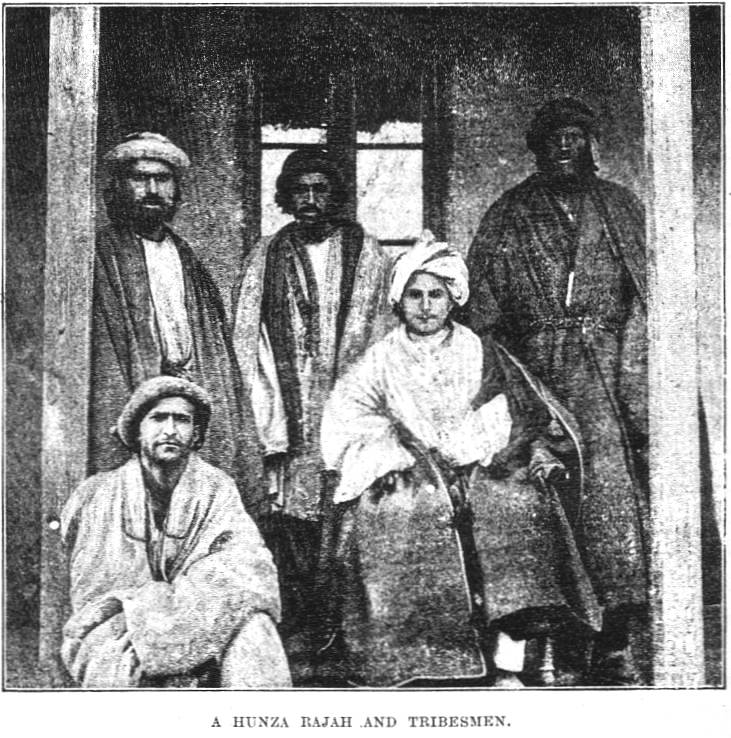
Hunza Rajah and Tribesmen in 1981.The British reported a population of about 8,000 people who were in good health and lived long lives, although their ages could not be verified since the Hunza people had no written records. The people were relatively healthy, especially when compared to the citizens in England where obesity, diabetes, cancer and heart disease ravaged the British due of their high carbohydrate diet of grains, bread, sugar, honey, fruit and potatoes. The Hunza people were slender, healthy and athletic in comparison to relatives of the British solders at home in England who were fat and sickly.

The Hunza tribesmen are shown in the picture. Click the picture to see an enlargement.

The Hunzakuts had lighter skin than the neighboring tribes and appeared to be of Caucasian origin. John Clark reported in 1950 seeing children with black, brown and blond hair and an occasional redhead. They probably chose the Hunza River Valley because of its sheer isolation, but the men took wives from neighboring peoples. Hunza women were said to have been beautiful. This is highly probably since the Persian women taken as captives were likely the best looking. See John Clark's book page 69.

The Hunza people were land poor since there was never enough space to provide plenty. Shortage was always present and people lived in fear of the springtime starvation when food ran desperately low.

Hunza had no soil as such. The river and glacial silt that formed the terraced gardens was simply ground rock. All of the animal manure was spread on the gardens to fertilize the crops and trees. The people defecated directly on the garden, and the soil was deficient in lime and phosphates causing the trees and plants to suffer. The garden yield was considerably less than in the United States and elsewhere where good soil is available. The nitrate fertilizer from animal and human excrement was quickly flushed from the silt by the weekly flooding with glacial water.

The Hunzakuts called this "the land of just enough." The truth is Hunza was always a land of never enough, and everything was in short supply including the usable land which was limited to five acres (20,000 sq. m) per family. Animals were limited because of the lack of grazing pastures in the lower valley. The goats, sheep and Yaks were moved to the higher mountains in summer in search of the sparse vegetation. The herdsmen had an excess of milk while the people in the valley suffered a shortage. This is the reason summer visitors to Hunza see a people eating a low-fat, near-vegetarian diet. The winter diet was vastly different.

Hunza River Valley


the Hunza River Valley in the 1870s. Hunza was a tiny kingdom located in a remote valley 100 miles (160 km) long and only one mile (1.6 km) wide, situated at an elevation of 8,500 feet (2590 m) and completely enclosed by mountain peaks. These peaks soar to a height of 25,550 feet (7788 m) and belong to the Karakoram Range, broadly known in the West as "the Himalayas." Hunza is now part of Pakistan in the northern section bordering on Afghanistan, Russia, China, Kashmir and India. The Kilik Pass leads to Russia and the Mintaka Pass to China.

The pass to reach Hunza from Gilgit, Pakistan was 13,700 feet (4176 m) high, a difficult and treacherous trail. Upon entering the valley the British found the steep, rocky sides of the valley lined with terraced garden plots, fruit trees and animals being raised for meat and milk.

The gardens were watered with mineral rich glacier water carried by an aqueduct system running a distance of 50 miles (80 km) from the Ultar Glacier on the 25,550 foot (7788 m) high Mount Rakaposhi. The wooden aqueduct trough was hung from the sheer cliffs by steel nails hammered into the rock walls. Silt from the river below was carried up the side of the valley to form and replenish the terraced gardens. The average annual precipitation in Hunza is less than two inches.

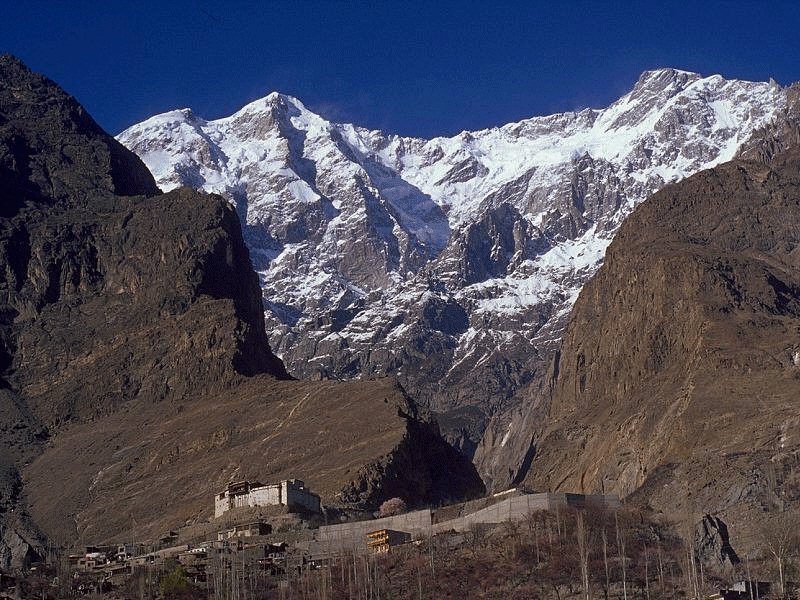
Ultar Peak near Baltit, Hunza.Ultar Peak rising above Baltit, the capital of Hunza, is spectacular. The Old Palace is on the hill above the village. Click the picture to see an enlargement.

The difficult trail into Hunza kept the people isolated. As late as 1950 most of the children of Hunza had never seen a wheel or a Jeep even though airplanes were landing at the airport in Gilgit, Pakistan only 70 miles (112 km) away. John Clark reported in his book, Hunza - Lost Kingdom of the Himalayas, that he could see three peaks above 25,000 feet and eleven glaciers all at once from Shishpar Glacier Nullah (canyon) overlooking the Hunza valley. See John Clark's book listed below on page 92.

The Hunzakuts, as they are called, had signed a peace treaty with their neighboring communities about 10 years prior to the arrival of the British. They had been a warrior community preying upon the Chinese trading caravans as they traveled the high mountain passes between Sin kiang and Kashmir. The Hunzakuts profited for a time by their thievery, plunder and murder, but they were hated by their neighbors. According to Hunzakut folklore, a peace treaty was signed because the Mir's son convinced his father to end their murderous ways.

Burushaski, the language of the Hunzakuts, is much different from other languages of the region and appears to be a mixture of the languages of Ancient Macedonian and the Hellenistic Persian Empire. However, the people also learned to speak the written Urdu language of Pakistan and other languages of the region.

Hunza Terraced Gardens.The terraced gardens were extensive with up to 50 cascading levels. The people lived in communities below. It was a considerable distance to walk for working in the fields. They had no roads or wheeled carts. All the grain and other produce was transported to the homes on the backs of men and animals. Click the picture to see an enlargement.

Everything in Hunza valley was always in short supply except crumbling rocks. Fuel for heating and cooking was severely limited, and fodder for feeding the animals was precious. Animal dung was used for garden fertilizer rather than fuel for fires as was done elsewhere. Supplies from outside of the valley were limited by the difficulty in bring goods over the high mountain pass. Highly prized goods brought in from the outside included guns, knifes, tools, metal pots, stoves, lamps, cotton cloth, silk cloth, thread, needles, matches, mirrors, glassware and some construction metals such as bolts, rods, sheet and plate. As late as 1951 these items had to be carried on the backs of men or animals. In past centuries traditional dress and bedding were made from sheepskins and other animal hides.

The original valley was mostly bare rock with a very limited amount of indigenous plant life. The sudden appearance of the vegetation in contrast to the surrounding barren rock earned the valley the description of being Shangri-La or the Garden of Eden. Given the hard work required to tend the gardens and animals, the description of Garden of Eden certainly did not apply to the Hunza River Valley.

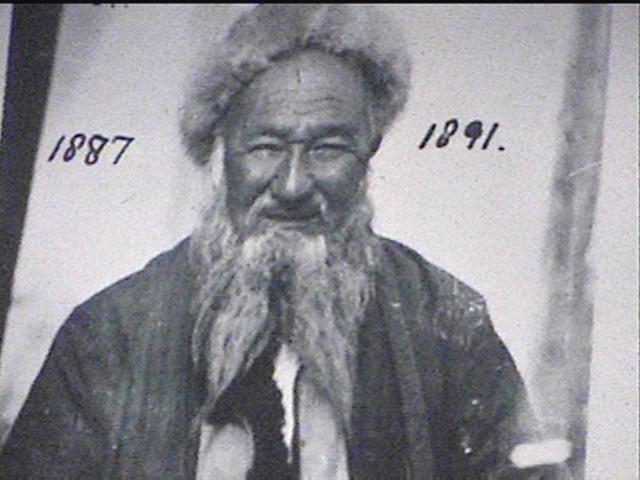
Mir Safdar Ali Khan in Hunza.Mir Muhammed Ghazan Khan I ruled from 1864 to 1886. Folklore stories say he sent his brother a gift of a cloak impregnated with smallpox and murdered his uncle and other brothers, but the facts are rather unknown. He was murdered in 1886 by Safdar Ali Khan who became the new ruler of Hunza. Mir Safdar Ali Khan is shown in the picture at the left. Click the picture to see an enlargement. In 1891 an expedition of 5,000 men lead by British Colonel Algernon Durand was attacked by the Hunzakut leader, Mir Safdar Ali Khan. The Mir fled to China and was replaced by his half-brother, Muhammed Nazim Klan. Mir Nazim Klan died in 1938 of mysterious causes, and it is highly suspect that his son, Muhammed Ghazan Khan II, was involved in his death. He died in 1946 and was replaced by his son, Muhammed Jamal Khan. Mir Muhammed Jamal Khan was deposed in 1974 by Pakistan although he maintained his property in Hunza. He died in Gilgit, Pakistan in 1976 were he also had a residence. Mir Muhammed Jamal Khan could also speak perfect English because he had been educated by the British as a boy. His descendents maintain their royal titles but have no ruling authority in Hunza.

Tuesday, July 7, 2009

Chapursan Valley

Yishkuk Lake, Zood Khun, Pakistan

Yishkuk Lake

We were unable to do the Rakaposhi trek due to cloudy weather to decided to spend the last 2 days in the Chapursun Valley, where few tourists go, but borders Afghanistan. We enjoyed beautiful scenery on the way and best jeep tracked we’d been on, including scary bits for Maggi. We stayed at Pamir Serai which is a Wakhi style home – 1 room around a hole in the ceiling, run by an enterprising local Alam Jan, sadly away in Kabul. Luckily a German Stefan, who had been staying for 2 weeks, who acted as our guide telling us things to do in the area. Chapursan Valley, Zood Khun, Pakistan

We went for a fabulous walk up to the lakes at Yishkuk, which were incredibly clear with beautiful colours, before being invited into a shepherds hut for chai and lassi.

The next day we went for a walk on the Yishkuk glacier, where there are some fantastic blue icebergs at the head – we broke of chunks of ice to drink from that were hard and crystal clear like huge diamonds.

Monday, July 6, 2009

Hunza Mountain


The mountain guides are indispensable for reaching areas that aid workers cannot access. Road assessments by the mountain guides show that many roads are still blocked by landslides and rockfalls, or are too dangerous to negotiate. The guides say that the situation will only worsen with the onset of the rainy season.The fabled Hunza Valley is nestled in the foothills of the Karakoram mountain range and since the 1950s its men have been guiding international climbing expeditions on some of the highest and most technical peaks in the world. The Hunza guides are renowned for their expertise in overseeing expeditions in remote mountain ranges, often involving over 1,000 porters and masses of equipment. The UN Office for Project Services (UNOPS) is using 25 local mountain guides from the Hunza Valley in northern Pakistan.

Golden Peak


Heights 7027m
Duration 30 days
Hotels 6 nights (Islamabad, Chilas, Skardu)
Season July-August
Average walking time 4-5 hours per day
Maximum group size 8-10 members
Equipments Tents, ice screw, snow bar, rope, ice axe, Harness
Subject Objective risks High altitude sickness, crevasses, unfavorable weather

Spantik Peak also Known as the Yengutz Peak situated between Nagar Valley near Hunza and Arandu Valley in Baltistan forming the

boundry Hunza-Nagar and Baltistan, is known by various names all depicting different aspects of its splendor and opulence. The northwestern face on the Nagar side is called “Ghenish Chhish”, which in Brushaski (local language) means Golden Mountain. Viewed from Hunza-Karimabad, the sun setting on Golden Pillar is a truly remarkable sight Local people also call it Queen Mountain. From the Baltistan side at the head of CHOGOLUNGME GLACIER the mountain is less intimidating and offers a NORMAL ROUTE to the summit . The summit on clear days presents magnificent views of neighboring Rakaposhi, Diran, Malubiting, Ultars, Battura Group, Haramosh, the entire Shimshal Mountains, and K2 far beyond and many more.

ITINERARY:

Day 1 ISLAMABAD: Arrive Islamabad.

Day 2 ISLAMABAD: Briefing at Ministry of Tourism./ Alpine Club Meeting with LO (Liaison Officer).

Day 3 SKARDU OR CHILAS: Fly to Skardu or drive to Chilas.

Day 4 SKARDU: Day free at Skardu or drive from Chilas to Skardu.

Day 5: SKARDU: Free Day at Skardu for final preparation.

Day 6 ARANDU : By jeep Skardu to Arandu.

Day 7 PUKPUN: 5 to 6 hours trek. Over night camping.

Day 8 KHUROMAL: Camping in Willow Grove and 5 to 6 hours trek.

Day 9 BOLOCHO: 4 to 5 hours trek.

Day 10 SPANTIK BASE CAMP: After trekking 4 to 5 hours we will reach Spantik base camp at 4300m. Over night camping.

Day 11 – 25 CLIMBING: Climb Mount Spantik. No. of days depends on weather, fitness, and experience of the climbers.

Day 26 – 29 SKARDU: Return back to Skardu via same route or cross Haramosh La towards Sassi.

Day 30 ISLAMABAD : Fly to Islamabad or drive to Chilas.

Day 31 ISLAMABAD: Day free at Islamabad or drive to Islamabad.

Day 32 DE BRIEFING: De-briefing at the Ministry of Tourism Alpine Club.

Day 33 ONWARD FLIGHT:

Thursday, July 2, 2009

The Land of Hunza


There are, of course, many theories about why the people of Hunzaland live so long. Patrick Flanagan, the founder of Micro Cluster technology believes that the water is the secret along with hundreds of other people who have been using his products. The King of Hunza Land was asked why their people live so long and he said "It's the Water." The lifestyle and diet likely play an important role but their water is very different then water in other parts of the world. However, the author of the following article has her own theories. The article does provide a good picture of the superior health of the inhabitants of Hunzaland. I found the following article at:

Travel tips

Pakistan is accessible both by air and land. Many airlines operate flights from (to) the international airports of Karachi, Islamabad and Lahore to (from) various major cities of the world daily. Rail and bus services operate between Lahore (Pakistan) and Delhi (India). Iran is also connected by rail and road. Road transport runs to Afghanistan via historic Khyber Pass. Khunjerab Pass (4730 meters) is the highest road of the world that connects Pakistan and China via Karakorum Highway, the ancient Silk Route (closed between January & April every year).
VISA REGULATIONS:
For detailed visa information and other travel regulations, please visit Pakistan Government's official website; www.tourism.gov.pk
BEST SEASON:
Different regions in Pakistan can be visited in different seasons. It is best to visit hot southern region in winter. But Northern Areas can be best visited in summer (May to October), however mid June to mid August for treks on high altitude and crossing passes. Late March and April is the best time to enjoy blossom and October & November to watch the colorful autumn in the picturesque valleys. January is the best month for limited hunting of the rear specie of ibex in accordance with wild life conservation rules.
MOUNTAIN FLIGHTS:
There are daily flight from Islamabad to Gilgit and Skardu and Peshawar to Chitral. Flights to Gilgit and Skardu are known for their breathtaking mountain scenery and are the most spectacular mountain flights in the world but subject to weather. We keep our vehicles standby at the airport for land transfer via Karakorum Highway, yet another thrilling experience.
PERSONAL BAGGAGE:
Mindful of extreme changes in weather in the mountains, your baggage should consist of reasonable quantity of clothing and other items of personal use. Baggage can be advised to those not experienced in Himalayan trekking. While preparing, please remember that excess baggage is always a burden. Our porters carry your duffel bags/rucksacks up to 12.5 Kilograms. You are expected to carry your back pack only.
PERMITS :
Traveling in Pakistan is free except certain border regions. Foreigners need a permit from the Ministry of Tourism for trekking on certain routes that have classified as 'Restricted Zone' and include K2 and adjoining glaciers, Chitral and Chilinji Pass. Rest of the valleys and mountains up to 6000 meter altitude require no permit. Climbing peaks over 6000 meter required climbing permit which is applied for a year in advance.
INSURANCE:
Foreign tourists are not insured for life, accident and belongings. Therefore, we advise you to get your self insured before proceeding to Pakistan. However we insure guides, camp crew and porters against any accident or loss during the tours.
ELECTRICITY:
Pakistan has AC 220 Volt 50/60 Amp. electricity.
TIME:
Pakistan Standard Time (PST) = +5.00 GMT
CURRENCY:
Rupee (Rs.) circulates in currency notes of 1000, 500, 100, 50, 10 & 5 and coins of Rs. 5, 2 & 1. Please visit www.forexpk.com for exchange rate updates.
TREK GRADES:
Trekking is only for those who enjoy walking and camping and for whom a bit of discomfort is rewarded by the splendour of nature in high mountains. Based on averages, we have graded different treks according to the level of difficulty. However no two persons are the same and it is for this reason that average walking hours may also vary from person to person.
Easy:
Maximum 5-6 hours daily walk on established trails with no extreme change in elevation.
Moderate:
6-7 hours walk with gradual altitude gains. Maximum altitude 4000 meters.
Strenuous:
Hard walking of 7-8 hours and sharp altitudes. Maximum altitude about 5000 meters. May involve fording streams and side trips or high passes as high as 5500 meter. May require rope and ice-axe. Mountaineering knowledge recommended.

HUNZA EXPERIENCE


based in the heart of Hunza, is an indigenous tour operating organization specialized in culture and adventure tours to the lofty mountains and unspoiled valleys of Northern Areas. As the name is self-indicative, we belong to the fabled Hunza Valley. With traditional hospitality of Hunzokuts and an innovative spirit of exploring new destinations, we offer an insight to the people and land with a deep sensibility of their values. Therefore, we do every possible effort to protect the unpolluted nature and society of these mountains.