
The Hunza people sun dried fruit in the summer and stored grain for winter consumption. They also had some meat. They consumed all parts of the animals, not just the flesh. They ate the animal's brain, lungs, heart, liver, tripe, flesh and everything else except the hide, wind-pipe and genitalia. They cleaned bones to a polish and broke them to eat the marrow. The fat was highly favored for cooking, and a stew was made by boiling meat and grains.
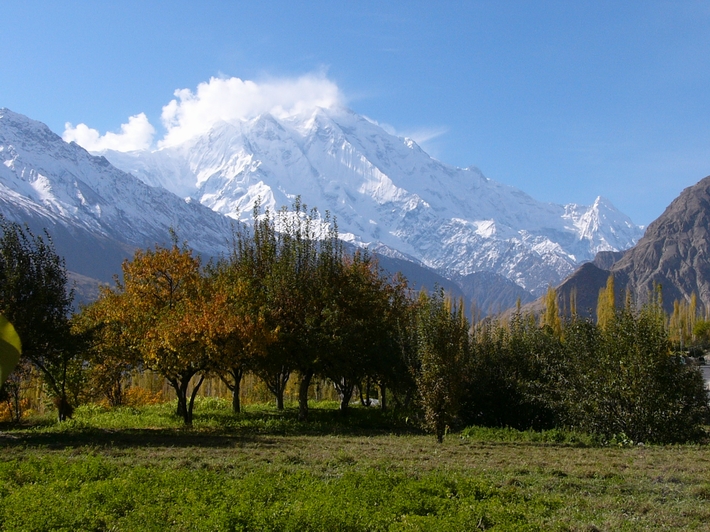
Mountain Karakoram as seen from Aliabad village
The Yaks, goats and sheep were bred each year for the meat and to keep the milk production flowing. The females were kept for breeding and milk production until reaching a non productive age when they were also slaughtered for food. Any lame animal was slaughtered to prevent the loss of meat. The food supply was critical and springtime starvation was always a concern for hungry children.
The Hunzakuts had a major flaw in their method of raising animals. They kept equal numbers of male and female, which reduced the productivity. If a Hunza farmer had six sheep he would have three ewes and three rams. The ewes would have three lambs each spring. The production could have been increased to five lambs each spring if they had kept five ewes and one ram. The rams also ate more fodder but produced no milk. The same was true for goats. This faulty farming practice reduced the amount milk, meat and number of offspring each year.
During the winter a major part of the diet consisted of milk, buttermilk, yogurt, butter and cheese. The diet was a high-fat diet throughout the year contrary to false claims that their diet was low-fat. The milk was more than 50 percent fat on a calorie basis and nothing was wasted.
The spring starvation was a difficult period for the Hunzakuts. The children were extremely thin and malnourished. Diseases abound and many died. The "healthy Hunza" claim made in many books and websites is strictly false.
Wednesday, July 8, 2009
Hunza Winter Diet.


The Original Hunza Summer Diet
The British General and soldiers arrived in the summer during the 1870s as did everyone who traveling to Hunza. This was the harvest season for the grains, fruits and vegetables from the gardens, and much of the food was consumed raw. Because fuel for cooking was saved to be used in winter for boiling meat and providing some heat for the stone dwellings, very little meat was consumed in summer and vegetable were eaten raw.
Curious visitors who followed the British soldiers to Hunza Valley years later naturally arrived in summer also, and the summer diet of the people led visitors to assume they were mainly vegetarian and ate very little meat. This was typical of the summer harvest season. Many primitive cultures including cavemen lived in a similar manner, gorging themselves on available fruit during the short season and eating mostly meat for the rest of the year. The people of Hunza differed in that they never had an abundance of anything except rocks. They did not have enough animals to provide abundant meat during the winter because of the lack of fodder. They did not want to kill female animals that were milk producers unless the animal was old or lame.
The Hunzakuts are said to have cultivated plants included barley, millet, wheat, buckwheat, turnips, carrots, dried beans, peas, pumpkins, melons, onions, garlic, cabbage, cauliflower, apricots, mulberries, walnuts, almonds, apples, plums, peaches, cherries, pears and pomegranates. John Clark did not find green beans, wax beans, beets, endive, lettuce, radishes, turnips, spinach, yellow pear tomatoes, Brussel sprouts or parsley. Cherry tomatoes and potatoes are thought to have been brought in by the British. The long list of currently grown plant varieties should not be a consideration when discussing the longevity of the Hunzakuts and their past diet.
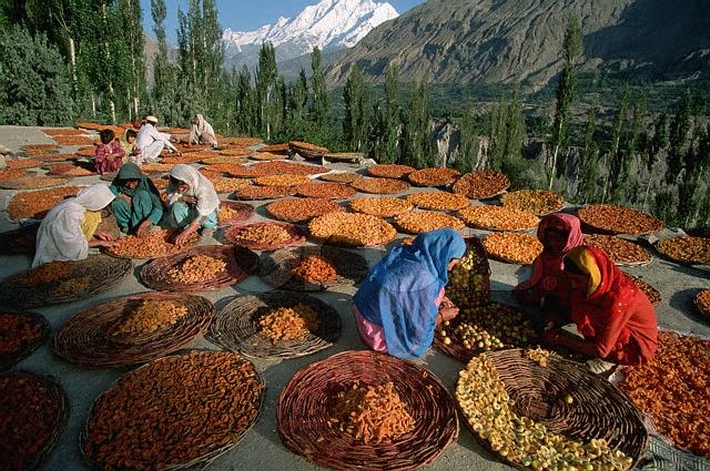
Apricot trees were very popular, and the fruit was eaten raw in season and sun dried for winter. The pits were cracked to obtain the kernel that was crushed to obtain the oil for cooking and lamps. The hard shell was kept for a fire fuel. The kernel and oil could be eaten from the variety of apricots with a sweet kernel, but the bitter kernel variety had an oil containing poisonous prussic acid. Click the picture to see an enlargement.
The apricot trees were allowed to grow very large in order to obtain the maximum yield. Picking the maximum amount of fruit was more important than the difficulty in picking. The children would scamper to the higher branches to pick or shake off the fruit. Planting new trees required several years of growth before any fruit was produced. The special garden silt or glacial milk did not contribute to the age or size of the trees as is commonly claimed. Our modern orchards are not managed that way because we have abundant space and picking is expensive. Our trees are cut when the size makes them difficult to harvest, not because they fail to live as long as those in Hunza.
Mulberries, which resemble blackberries in size and shape, are a favorite fruit. When fully ripe, their flavor is sweet-sour but somewhat bland. The variety grown in Hunza was most likely a golden color.
A large variety of indigenous wildlife including markhors sheep, Marco Polo sheep, geese, ducks, pheasants and partridge provided the early Hunza hunters with meat in addition to their sheep, goats and domesticated Yaks. Chickens were also raised for meat and eggs until sometime in the 1950s when they were banned by the Mir.
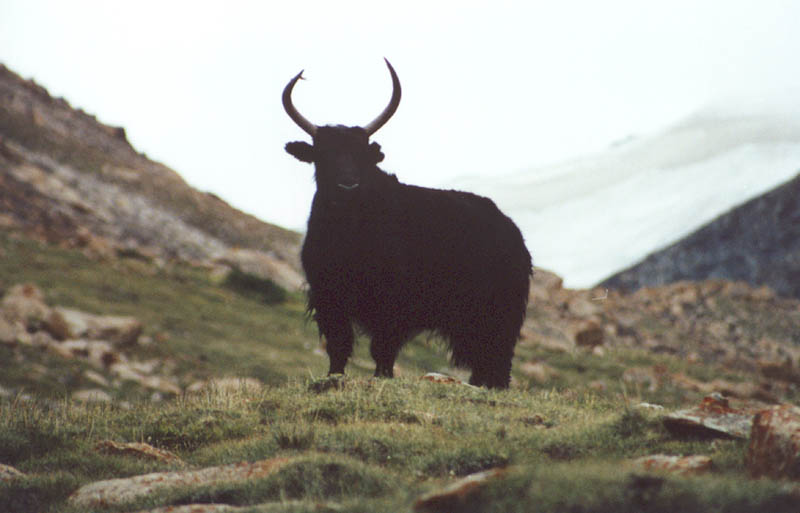
The Queen and her children traveled on Yaks while the King and other men rode horses. The Yak is a strong wild animal which they domesticated for for traveling in the mountains as a beast of burden pack animal. In addition to Yaks, which provided milk and meat, the Hunzakuts also had goats, sheep, cows and horses. However, there were very few cows or horses in Hunza in 1950 because they consumed a lot of fodder compared to goats and sheep. The Yaks, goats and sheep were herded in the summer to areas just below the snow line for feeding on sparse grasses and plants. They were milked by the herders who made butter that was delivered back to the people in the villages below. The herders had plenty of milk to drink that valley people lacked. The Yaks were also milked. Cows and horses could not be herded to the higher elevation because the vegetation there was simply to sparse.
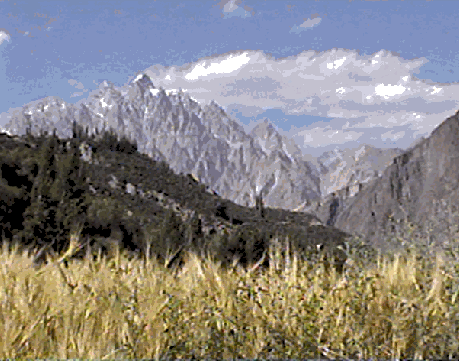
The picture is of the Cathedral Peaks as viewed from the village of Ghulmit 23 miles (37 km) upriver from Baltit near the northern end of Hunza. Summer grains are seen growing in the foreground. The Mir's main Palace was in Baltit, but since firewood was more abundant in Ghulmit, he chose this location for his winter residence. Click the picture to see an enlargement.
A great celebration was held to commemorate the barley harvest, the first harvest of the early summer to break the spring starvation period. The barley was ground, mixed with water and fried to make a pancake style bread called chapatis, and hot stones were used for cooking the bread prior to the availability of steel plate or cast iron griddles. The bread recipe would change to whatever grain was available. Wheat was harvested later in the summer. The Hunza bread recipe found in books and on websites is nothing whatsoever like the various breads of the Hunzakuts. The primitive Hunzakuts ground grains between two rocks much like the North American Indians. They had constructed a water wheel powered stone grinder by the time John Clark had arrived, but many people still ground the grain by hand.
To their credit, the Hunzakuts did developed a double-crop farming method. Barley was the first crop harvested, then replaced by millet. Wheat was harvested later in the summer followed by winter buckwheat. The double-crop planting method was done to make the maximum use of the valuable land, not because grains matured faster in Hunza as often claimed.
In summer meat was conserved for very special occasions and festivals. Livestock were much too valuable to be killed indiscriminately, so animals became a major source of food only during the cold winter when other foods ran out.
The Primary Books Written About Hunza
John Clark (1909 - 1994) earned his doctorate in geology at Princeton University in 1935. As an officer in the U.S. Army Corps of Engineers, Clark explored nine thousand miles of roads and trails in Kansu and Sinkiang, China. Clark decided to help the people of Hunza because of his wide geological experience and some medical expertise. He went to Hunza in 1950 and 1951 and wrote the book, Hunza - Lost Kingdom of the Himalayas, in 1957. University in 1935. He traveled by horseback over the rugged and dangerous trail for 70 miles from Gilgit and found the people to be strong, intelligent and proud of their independence. In his 20 month stay, he got to know the Hunza people on a personal level, and with his 20 years experience in first aid as a field geologist, he ran a free dispensary where he treated 5,684 patients with sulphas, penicillin, paludrines, atabrine, undecylenic acid and other drugs. His reference medical books were Cutting's Manual of Therapeutics, the Merck Manual, Gardiner's Handbook of Skin Diseases and Medical Council practice papers. See page 75 in the 1957 first edition of the book. The pages in the pdf file below do not match the pages in the book.
Clark traveled to investigate the geology of the entire region searching for natural resources such as minerals or metals. He brought in new vegetable seeds and taught basic carpentry and crafts to a school of boys. Clark's book is exciting reading and describes the Hunza people in great detail. It is an excellent resource.
This picture shows the Hunza River in winter near Aliabad with Mountain Rakaposhi in the background. The stream and canyon entering the valley from the left is Hasanabad Nullah. This is one of the many ravines that Clark explored. The valley does not get much snow in winter even though temperature falls below zero degrees Fahrenheit (-10 C). Click on the picture to see an enlargement.
On his first trip through Hunza Clark reported he acquired almost all of the same misconceptions as others: "the healthy Hunza, the Democratic Court and the land where there are no poor." He soon found the actual situation to be much different.
Dr. Allen E. Banik and Renee Taylor wrote the book, Hunza Land, in 1960. They describe Hunza on the front inside of the dust jacket. "They have no money, no poverty, no disease, no police and no jails." All of these claims are false. Their money was the Pakistan rupee as they were a part of Pakistan. They had poverty. Those who could not grow their own food simply starved to death. Family groups were staunhly independent and did not help others as Dr. Banik claims. They had considerable disease and often flooded into John Clark's dispensary for treatment. They had a ruling organization in each village with men serving in security positions. The Mir had armed body guards that kept out of sight of the visitors. They had a penal colony at Shimshal Valley in the north end of the valley where inmates attended to flocks of sheep owned by the Mir. It was a dreadful sentence to be banished to Shimshal. The winters were icy cold and the high winds blew continuously. The claims in this book about the diet, health, longevity, and honesty of the Hunza people are false.
Renee Taylor, a lecturer, linguist and world traveler, wrote the book, Hunza Health Secrets For Long Life and Happiness, in 1964. She traveled to Hunza during the summer of 1960 over a Jeep road that had just been built a few years previously. Taylor lived a couple of months as a guest of the Mir at his palace in the Hunza capital of Baltit. She traveled very little and did not get the opportunity to develop any close personal relationships with the common Hunzakut. Taylor heard only filtered information presented by the Mir, his staff and selected individuals. Unfortunately Taylor did not learn the truth while in Hunza. She never ventured out alone to live with the people and learn the truth behind this facade. Her movements were strictly controlled by the Mir, and she was presented an orchestrated view of Hunza that the Mir wanted her to pass on to the world.
Scarcely two consecutive sentences in Taylor's book can be read without finding errors, distortions and blatant untruth. The Hunza people certainly did a good job of deceiving her. Renee Taylor appears to have ventured to Hunza with an agenda to proclaim the Hunzakuts to be the most healthy and long-lived people on the earth while subsisting on a low-fat, mostly vegetarian diet. These claims are false.
The Original Hunza People


The story of Hunza is thought to have begun with Alexander III or Alexander the Great (July 356 BC to June 10, 323 BC), son of King Philip of Macedon (Ancient Macedonia west of Greece). Alexander was a brilliant warrior, more capable than his father. After his father's murder, Alexander set out toward the east to conquer neighboring kingdoms. He conquered Greece in short fashion and continued toward Persia where he eventually burned the capital and the national library in a great defeat of the Persians.
Three generals in Alexander's army are said to have married Persian women. The generals betrayed Alexander by giving the Persians his plans. When Alexander heard of the betrayal he sought to take revenge, but the generals, wives and a band of many soldiers fled. The valley of Hunza is thought to have been their valley of refuge because of its remote and secure location.
It is likely that the Hunza valley was already sparsely inhabited when the Macedon generals arrived. Certainly these tough fighting warriors made quick work of slaughtering the ancient inhabitants of Hunza. Though this is purely speculation, it is highly probable. The desolate rocky valley could not have supported the Macedonians unless some farms had been slowly built by others over the preceding centuries.
Hunza became an independent kingdom with a monarchy. The King used the title of Mir. The British disrupted the ruling organization of the Hunza people.
"The Mir, or ruler, of Hunza believed his tiny kingdom to be the equal of China, and likened himself to Alexander the Great from whom he claimed descent. When the British turned up in the 1870s he took them for petitioners seeking to make Queen Victoria his vassal. Not wishing to waste time arguing, the colonial officials had him deposed, replacing him with an amenable brother whom the Mir had carelessly neglected to murder on his way to the throne."
The British reported a population of about 8,000 people who were in good health and lived long lives, although their ages could not be verified since the Hunza people had no written records. The people were relatively healthy, especially when compared to the citizens in England where obesity, diabetes, cancer and heart disease ravaged the British due of their high carbohydrate diet of grains, bread, sugar, honey, fruit and potatoes. The Hunza people were slender, healthy and athletic in comparison to relatives of the British solders at home in England who were fat and sickly.
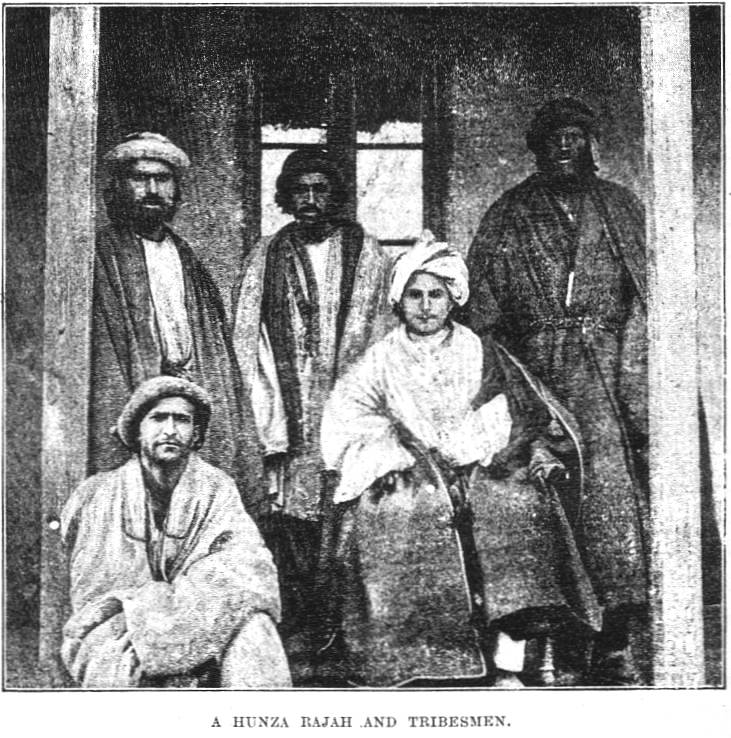
The Hunza tribesmen are shown in the picture. Click the picture to see an enlargement.
The Hunzakuts had lighter skin than the neighboring tribes and appeared to be of Caucasian origin. John Clark reported in 1950 seeing children with black, brown and blond hair and an occasional redhead. They probably chose the Hunza River Valley because of its sheer isolation, but the men took wives from neighboring peoples. Hunza women were said to have been beautiful. This is highly probably since the Persian women taken as captives were likely the best looking. See John Clark's book page 69.
The Hunza people were land poor since there was never enough space to provide plenty. Shortage was always present and people lived in fear of the springtime starvation when food ran desperately low.
Hunza had no soil as such. The river and glacial silt that formed the terraced gardens was simply ground rock. All of the animal manure was spread on the gardens to fertilize the crops and trees. The people defecated directly on the garden, and the soil was deficient in lime and phosphates causing the trees and plants to suffer. The garden yield was considerably less than in the United States and elsewhere where good soil is available. The nitrate fertilizer from animal and human excrement was quickly flushed from the silt by the weekly flooding with glacial water.
The Hunzakuts called this "the land of just enough." The truth is Hunza was always a land of never enough, and everything was in short supply including the usable land which was limited to five acres (20,000 sq. m) per family. Animals were limited because of the lack of grazing pastures in the lower valley. The goats, sheep and Yaks were moved to the higher mountains in summer in search of the sparse vegetation. The herdsmen had an excess of milk while the people in the valley suffered a shortage. This is the reason summer visitors to Hunza see a people eating a low-fat, near-vegetarian diet. The winter diet was vastly different.
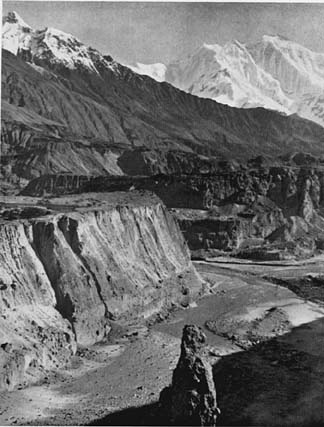
Hunza River Valley

the Hunza River Valley in the 1870s. Hunza was a tiny kingdom located in a remote valley 100 miles (160 km) long and only one mile (1.6 km) wide, situated at an elevation of 8,500 feet (2590 m) and completely enclosed by mountain peaks. These peaks soar to a height of 25,550 feet (7788 m) and belong to the Karakoram Range, broadly known in the West as "the Himalayas." Hunza is now part of Pakistan in the northern section bordering on Afghanistan, Russia, China, Kashmir and India. The Kilik Pass leads to Russia and the Mintaka Pass to China.
The pass to reach Hunza from Gilgit, Pakistan was 13,700 feet (4176 m) high, a difficult and treacherous trail. Upon entering the valley the British found the steep, rocky sides of the valley lined with terraced garden plots, fruit trees and animals being raised for meat and milk.
The gardens were watered with mineral rich glacier water carried by an aqueduct system running a distance of 50 miles (80 km) from the Ultar Glacier on the 25,550 foot (7788 m) high Mount Rakaposhi. The wooden aqueduct trough was hung from the sheer cliffs by steel nails hammered into the rock walls. Silt from the river below was carried up the side of the valley to form and replenish the terraced gardens. The average annual precipitation in Hunza is less than two inches.
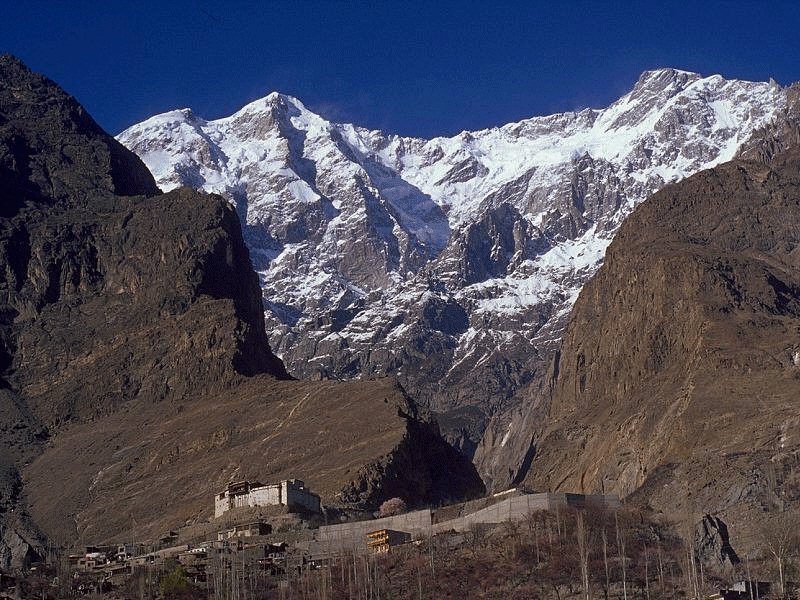
The difficult trail into Hunza kept the people isolated. As late as 1950 most of the children of Hunza had never seen a wheel or a Jeep even though airplanes were landing at the airport in Gilgit, Pakistan only 70 miles (112 km) away. John Clark reported in his book, Hunza - Lost Kingdom of the Himalayas, that he could see three peaks above 25,000 feet and eleven glaciers all at once from Shishpar Glacier Nullah (canyon) overlooking the Hunza valley. See John Clark's book listed below on page 92.
The Hunzakuts, as they are called, had signed a peace treaty with their neighboring communities about 10 years prior to the arrival of the British. They had been a warrior community preying upon the Chinese trading caravans as they traveled the high mountain passes between Sin kiang and Kashmir. The Hunzakuts profited for a time by their thievery, plunder and murder, but they were hated by their neighbors. According to Hunzakut folklore, a peace treaty was signed because the Mir's son convinced his father to end their murderous ways.
Burushaski, the language of the Hunzakuts, is much different from other languages of the region and appears to be a mixture of the languages of Ancient Macedonian and the Hellenistic Persian Empire. However, the people also learned to speak the written Urdu language of Pakistan and other languages of the region.

Everything in Hunza valley was always in short supply except crumbling rocks. Fuel for heating and cooking was severely limited, and fodder for feeding the animals was precious. Animal dung was used for garden fertilizer rather than fuel for fires as was done elsewhere. Supplies from outside of the valley were limited by the difficulty in bring goods over the high mountain pass. Highly prized goods brought in from the outside included guns, knifes, tools, metal pots, stoves, lamps, cotton cloth, silk cloth, thread, needles, matches, mirrors, glassware and some construction metals such as bolts, rods, sheet and plate. As late as 1951 these items had to be carried on the backs of men or animals. In past centuries traditional dress and bedding were made from sheepskins and other animal hides.
The original valley was mostly bare rock with a very limited amount of indigenous plant life. The sudden appearance of the vegetation in contrast to the surrounding barren rock earned the valley the description of being Shangri-La or the Garden of Eden. Given the hard work required to tend the gardens and animals, the description of Garden of Eden certainly did not apply to the Hunza River Valley.
Tuesday, July 7, 2009
BATURA GLACER

Battura Glacier - Shimshal Valley Heli Trip
Range: KARAKORAM
Zone: Open
Duration: 11 Days
Best Time: Mid April - End October
Heli treks combine the thrill of trekking in the glacial surroundings around Biafo/Hispar with the pleasure of flying over the colorful valleys of Shimshal and Hunza in their spring and Autumn glory affording magnificent mountain scenery with glimpses of Latoks, Diran, Paiyu, Kanjurth Sar, Dastagil Sar, Momhill sar, etc. It is for people who want a short holiday in the mountains with its physical and visual pleasures.
Trip Itinerary:
Day 01 Islamabad:
Arrive Islamabad. Transfer to hotel.
Day 02 Skardu/Besham:
a) Fly to Skardu subject to weather. Transfer to Hotel.
b) In case of flight cancellation drive to Besham. Hotel.
Day 03: Free day at Skardu for sightseeing or complete road journey to Gilgit. Hotel.
Day 04 Hunza:
Drive to Hunza. Afternoon sightseeing. Hotel.
Day 05 Battura Glacier/Shimshal Valley:
a) Heli trip over Battura glacier and Shimshal Valley and land at Gulmit. Hotel.
b) In case of cancellation of heli flight due to bad weather then excursion to Khunjerab Pass and back to Gulmit. Hotel.
Day 06 : 2nd spare day for heli flight or excursion to Gulkin Glacier, Borit Lake. Hotel.
Day 07: 3rd spare day for heli flight or drive to Hunza and excursion to Hoper Glacier. Hotel.
Day 08: Drive to Gilgit. Hotel.
Day 09: Fly to Islamabad or drive to Besham. Hotel.
Day 10: Day free at Islamabad or drive to Islamabad. Hotel.
Day 11: Transfer to airport for your homebound flight.
Services Included:
* Airport/road transfers in AC coach and four wheels drive jeep.
* Helicopter expenses as per itinerary on hourly basis.
* Hotel accommodation with all meals.
* Services of English speaking guide.
* Porterage at airport and hotels, toll taxes and parking fee etc.
* Insurance of our guide.
Shimshal Valley


Shimshal Valley is one of the remotest valleys of the Hunza Valley. It was supposed to be a place of exile for theives and dacoits in the earlier times (something like Siberia and Australia) but it is no less beautiful. The jeep track just leaves the KKH just north of Passu for Shimsal which is one of the most wonderful places in Hunza. No thieves or dacoits now! You can also take the much more interesting hiking route to Shimsal. Porters are easily
